

Public art museums are expected to operate with a healthy degree of curatorial autonomy, whereby the professionals at the institution are allowed to make decisions about the institution’s exhibitions, collections, and programmes, without undue political or personal pressures and interference. Naturally, such institutions are expected to operate within their mandate, and guided by the relevant policy and legal frameworks. They are also expected to be accountable to the communities and stakeholders they serve, to be open to public consultation and dialogue on their exhibitions, programmes, and general direction, and to be firmly committed to inclusion and diversity. That could never mean, however, that the museum is up for grabs for external parties to have, or impose, exhibitions or programmes that compromise institutional standards.
The crucial governance principle at stake here is that a museum is an institution and not a venue. This means that museums ought not to be forced to support and accommodate external projects that reflect personal, commercial, or political agendas or that may not be relevant or appropriate to the museum. While productive collaborations are to be welcomed, external parties should not be able to dictate exhibitions and programmes, as the museum is accountable for its curatorial and artistic standards, and its use of public funds and resources. Clear rules of engagement are necessary, such as duly communicated policies regarding external exhibition proposals and there never ought to be an obligation, on the part of the museum, to accept any such proposal. Such policies should be supported, not undermined, by the political directorate but that is, ironically, where the pressure often comes from to make exceptions.
As one who worked in various positions at the National Gallery of Jamaica between 1984 and 2018, I can affirm that the pressures for other parties to stage exhibitions that would breach the museum’s standards and policies on external exhibitions were constant and at times enormous, coming from well-connected individuals, artists, embassies, ministers, and even other government entities. My colleagues elsewhere in the Caribbean have similar tales to tell, with pressures that reflect a blatant disregard for the practices and standards that should govern a public art museum. What is fundamentally at stake in such instances is the museum’s powers of legitimization, which is a power that should be used judiciously and not to justify problematic projects. Another, more practical factor in these pressures is also the lack of alternatives, in terms of well-equipped, suitably located, and rentable exhibition space in many Caribbean cities, Kingston, Jamaica, included.
As is the case in most museums, the majority of the NGJ’s exhibitions have always been internally curated or curated by guest-curators contracted by the gallery. It has, however, also been recognized that including select touring exhibitions can add substance and diversity to the exhibition programme. For most of its history, the NGJ has accepted external exhibitions selectively, when they were professionally curated, of an appropriate standard, relevant to the NGJ’s mandate and programme direction, and offered on an institution-to-institution basis, as is the norm for public art museums. Such exhibitions also had to be fully funded, resulting in only minimal expenditure for the NGJ, as there was no budgetary provision for such exhibitions (and often no budgetary provision for exhibitions at all!). It was always made very clear, when such exhibitions were accepted, that the NGJ would have ultimate curatorial authority over its presentation (and would thus also be accountable in case of any controversies or challenges), although such projects of course always involve collegial collaboration with other curators and institutions. As the late Chief Curator David Boxer used to insist, all exhibitions shown at the museum needed to be regarded as NGJ exhibitions, irrespective of their origin and the collaborations involved.
Some memorable touring exhibitions came to the NGJ through diplomatic, and quasi-diplomatic channels such as the British Council and USIS. This included a Jacob Lawrence print exhibition in the 1980s, which came to Jamaica through USIS, and the Aubrey Williams retrospective in the late 1990s, which originated at the Whitechapel Gallery in London and was toured in the Caribbean by the British Council. As a rule, private exhibition proposals were not entertained, but the NGJ’s policy on this subject was frequently challenged, which resulted in some unpleasant situations whereby certain individuals used their formidable social and political capital to try to force the issue. There were also pressures from embassies to show diplomatic exhibitions that were not suitable for the NGJ. The NGJ however always held firm to its position of principle.

It appears that in recent years, the NGJ has abandoned this hard-won position and is now quite prepared to operate as a venue for third-party exhibitions. Last year, on a visit to the NGJ I happened upon the hasty mounting in the mezzanine area of an unannounced exhibition of carnival photography from the Dominican Republic, ambitiously titled The World Upside Down. I was told by a senior member of staff that the exhibition had come through the Dominican Embassy and that the curatorial staff had been instructed to mount it, without specifying who had done the instructing.
I was shocked at the poor quality and production values of the photos and, particularly, that several of them featured figures in blackface, which seemed unfortunate, given the Dominican Republic’s troubled internal racial dynamics and history of racist and xenophobic policies and actions towards neighboring Haiti. The exhibition, which was on view for just a few days and publicly acknowledged by the NGJ only after it had closed, was held along with a “Dominican Week” reception at the NGJ and a trade mission. While it may have been presented in a spirit of diplomatic goodwill by the Dominican Embassy, it was an all-time low in the NGJ’s exhibition history and a serious blunder on the part of its leadership. That exhibition should never have been shown at the NGJ.
As I stated at the time, my issue was not that there was a Dominican exhibition at the NGJ, as more Caribbean exchange exhibitions are needed in Jamaica, but I believe that such initiatives are better handled on an institution-to-institution basis and supported by the respective embassies, rather than as direct diplomatic courtesies. My concern was about the quality and substance of the exhibition and the apparent lack of professional consultation with the NGJ curatorial staff, who did not seem to take any responsibility for the decision to stage it when I inquired about it. Having the exhibition at the NGJ, however, conveys to the public that its leadership was entirely comfortable with the exhibition and prepared to lend the NGJ’s name and reputation to it.
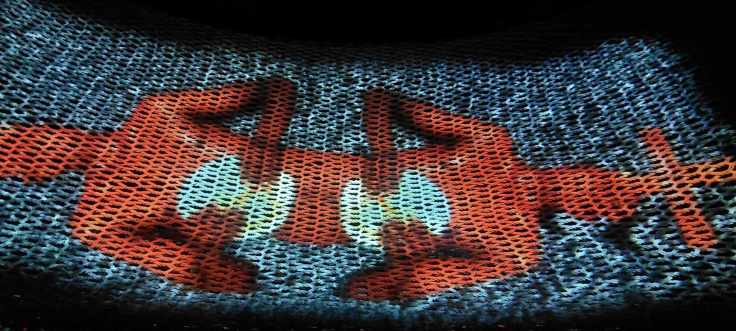
I was surprised to learn, then, early last week that another Dominican exhibition was being staged at the NGJ, which was announced at very short notice on the Instagram account of the Dominican Embassy in Kingston and in which the NGJ was tagged. The flyer highlights the Embassy as the principal organizer, while the NGJ and the Ministry of Culture, Gender, Entertainment and Sport (MCGES) seem to appear as secondary partners, along with two other Dominican organizations. The exhibition, which again opened as part of Dominican Week and which will be on view until May 7, consists of a multi-media installation project titled Overlapping by the Dominican artist and architect Raúl Morilla, an artist I did not know about previously.
I am not sure how the showing at the NGJ of this year’s exhibition came about and whether there was more consultation with the curatorial staff this time around. It is instructive that there is no mention of the exhibition on the NGJ’s other social media accounts, and that the exhibition was not listed in the exhibition calendar the NGJ published recently. This reinforces the sense that this is an exhibition held at the NGJ by the Embassy and furthermore scheduled at short notice. Perhaps there was a need for a more credible “do-over” after last year’s debacle, and this year’s exhibition indeed looks far more interesting and appropriate, but that is besides the bigger point I seek to make here. The question indeed arises whether the NGJ will now be expected to host an annual Dominican Week exhibition and what the broader implications are for the NGJ’s exhibition programme, going forward.
The two recent Dominican diplomatic exhibitions at the NGJ set precedents that undermine the NGJ’s institutional integrity as a national art museum. What moral authority does the NGJ now have to reject any diplomatic or private exhibition proposal, irrespective of standards or relevance, lest it be accused of favouritism? And what degree of autonomy does the NGJ’s current curatorial staff still have to make professional decisions about such matters? Has the NGJ now finally become a mere venue, the “exhibition facility at the bottom of Orange Street” as one senior politician notoriously used to call it, instead of a cultural institution? If these issues are not handled more thoughtfully, based on sound (and courageous) leadership and grounded in a greater sense of professional principle, the NGJ’s curatorial autonomy and standards will be eroded even further, even though this is already a widely shared concern. It appears that the NGJ needs to engage in some serious reflection on its exhibition policies and communicate these clearly to the public and stakeholders, while being consistent, transparent, and unbiased with their application.
There is also an urgent need for a multi-purpose cultural centre in Kingston (and possibly in other Parish capitals), where appropriately sized and equipped exhibition space is available for rental for suitable projects – a place that can rightly be called an “exhibition facility”. This would provide artists and artist groups with much-needed exhibition space options, and it could also be used by JCDC for its annual art exhibition, which is now shown at the Kingston Conference Centre, under circumstances, semi-open to the elements, that do little justice to the artists and the art works exhibited. There would also be scope for diplomatic exhibitions such as the ones now shown at the NGJ. Having such a cultural centre is crucially needed if the vision for a Kingston Art District is to become a reality. Perhaps the Ministry of Culture, Gender, Youth and Sport should join forces with Kingston Creative to make that happen?
This post was originally published in the Monitor Tribune of April 21, 2024 and is reproduced here with a few changes and additions.
 Perspectives
Yes, Kingston lacks good and suitably appointed exhibition space…It would be good if Min of Culture or other private entity could initiate this. A welcome support for the visual arts which is so sadly lacking.
LikeLike
It is so needed. And it would take the pressure off the NGJ to have to be everything to everybody, because that is part of the problem.
LikeLike
This is amazing
LikeLike