

When The Face of Us was announced by the National Gallery of Jamaica as an upcoming juried exhibition, mid last year, I was admittedly skeptical. The recent curatorial debacles of the populist, dramatically uneven 2019 Summer Exhibition and the incomprehensible Narrative Evolutions (2023) did not inspire much confidence about the National Gallery’s current capacity to mount compelling, museum-quality exhibitions. The call for submissions for The Face of Us was so poorly written and articulated, with awkward, stilted phrases such as “artworks of portraiture” or “the portrait as the main image approach”, that it was not clear what was being sought. The verbiage strongly suggested that the call was for conventional, representational portraiture and it was not clear whether other possibilities would be entertained. If the exhibition concept was meant as a more open-ended creative and critical provocation, as is now rather defensively claimed by the National Gallery, it should have been framed as one such, as the original wording created significant confusion on that count. The Gallery really needs to do something about the quality and clarity of the writing for its public communications and the manner in which its exhibition concepts are articulated, as both have been seriously flawed recently.
The title of The Face of Us immediately raised questions, the first of which was, of course, who this “us” might be. The question was raised at the July 21, 2023, information session on Instagram Live and the answer was “Jamaicans.” The problem is, of course, that with every articulation of an “us”, others become the “not us” who are being marginalized and excluded from the conversation. Invoking a collective “us”, unless it is carefully moderated and contextualized, inevitably asserts a dominant norm, which is assumed to be undifferentiated and broadly shared, while the reality is almost always more complicated and contested. This is not only a matter of who is a Jamaican, and who is not (although this too may be a matter of debate, especially in the context of the Jamaican Diaspora, where such identifications become a lot more open-ended). It also glosses over the significant diversity (and sometimes sharp divisions) that exist within the various conceptions of “the Jamaican”, in terms of race and class, values and beliefs, and gender and sexual orientation, just to mention a few.

In a sense, furthermore, the National Gallery is reinventing the wheel here since a significant part of the story of Jamaican art has revolved around engaging with those very questions. The exhibition apparently took its cues and its title, from The Face of Jamaica, a touring exhibition of Jamaican art which was shown at several venues in Germany and England in 1963-64, as a cultural diplomacy effort associated with the country’s rum trade, but never seen in Jamaica. The Face of Jamaica was not a portrait exhibition, although a number of portraits were included. The Face of Us appears to have been construed as a sort of retort to the outward-looking agenda of The Face of Jamaica, which was curated for the consumption of European audiences, but perhaps the organizers should have taken a closer look at the exhibition itself. The work in the exhibition was in fact quite representative of the state of art in Jamaica around Independence and reflected a thrust towards greater diversity, in which previous conceptions about an undifferentiated and uncritical “us” were challenged. (An online reconstruction of this seminal exhibition, researched and compiled by the late Petrine Archer-Straw and Claudia Hucke, can be found at: https://exhibits.uflib.ufl.edu/aboutface/.)
The National Gallery itself has mounted two portrait exhibitions in the past. The Self and Each Other, held in 1977, consisted of self-portraits and portraits of other artists, and collectively, presented an inspired and instructive “portrait” of the Jamaican art world in the turbulent but culturally generative late 1970s. The other, more recent one, Explorations V: Portraits in Dialogue, opened in late 2017, and consisted of portraits from the collection from the 18th to 21st century that, brought into dialogue with each other, addressed some of the issues The Face of Us ought to explore. The question arises, therefore, why it was deemed necessary to have another exhibition focused on portraiture while so many other aspects of the National Gallery’s exhibition programme, such as the Summer Exhibition and the Kingston Biennial, appear to be lagging behind.
In her remarks at the (mercifully short) opening function of The Face of Us on December 10, the exhibition curator Monique Barnett-Davidson cited an anecdote, conveyed in a published interview with Albert Huie, whereby a local woman whose portrait he wished to paint declined and questioned her suitability for such representations, implying that painted portraits were something for the elite. What a difference it would have made if this anecdote had been cited in the call for submissions! Barnett-Davidson rightly added that this work continues today, and questions of identity, visibility/invisibility, and representation indeed loom large in contemporary Jamaican art, albeit with new critical perspectives and formal approaches. So perhaps there is scope for further reflection on these issues after all, and further exploration of the contemporary practice of portraiture.
Despite these misgivings, I will be the first to admit that the exhibition itself exceeds my expectations, certainly in terms of its overall quality. There are a few substandard entries, of the kind one expects to see in the Festival exhibition, but there are also quite a few outstanding, even stunning works that compellingly address the issues at hand. The crisis, clearly, is not with the artists, who continue to produce outstanding work. I can only hope that there will be an astute and well-planned public education programme to support further critical engagement with these works, and to compensate for the deficiencies in the original framing of the exhibition.
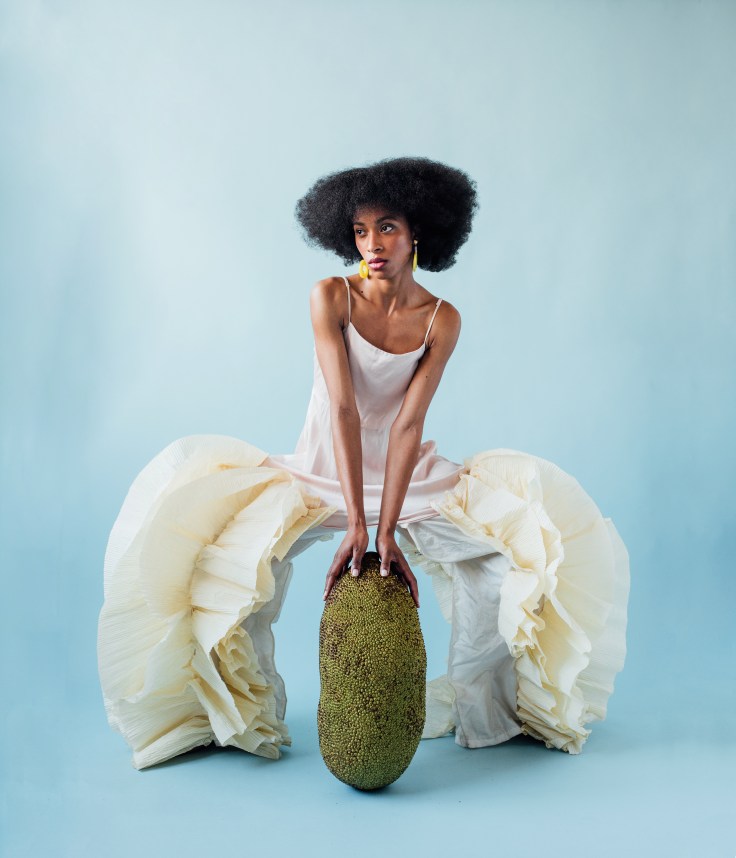
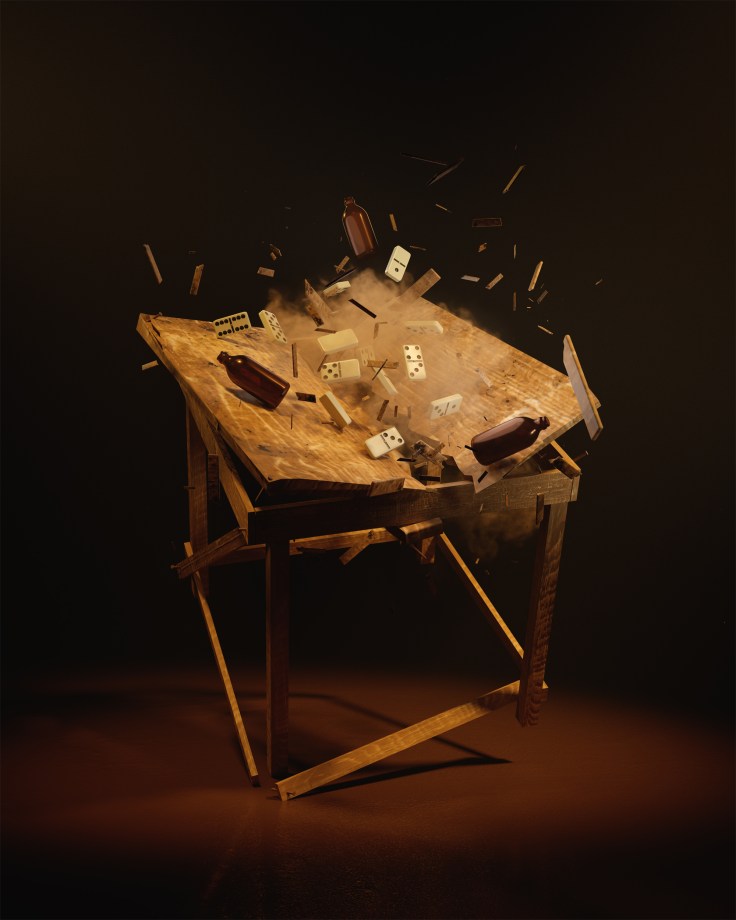
Some of the most exciting works in the exhibition come from artists who had not exhibited at the National Gallery or in Jamaica before, such as Acquille Dunkley and Janice Reid. Dunkley’s visually striking digital images use iconic aspects of Jamaica’s material culture, such as the dominoes table or the jerk pan, adding surreal life to these inanimate objects by removing the human presence and presenting them in the fashion of formal portraits. Reid’s photograph, Fancy Dress (The Fanny Eaton Series), which has similar surreal resonances,reflects on the story of Fanny Eaton, the favoured model and muse of the Pre-Raphaelites, but flips the representational script to focus on Eaton’s Jamaican heritage, using a large jackfruit as a visually disruptive but defining element.
Recent Edna Manley College graduates are also well represented, with strong entries by Sasha-Kay Nicole, Tajae Pringle, Rohmearo McFarlane, Sonn Ngai, Dushaine Lorraine, Tishana Fisher, Natasha Cunningham, Zohria Allen, and Maurice Hibbert. This is excellent, as there had been no exhibition opportunities for young and emerging Jamaican artists at the National Gallery recently. And there is also work by other artists who have been quietly producing compelling bodies of work in recent years, such as Michele Lee Lambert and Oliver Myrie. The latter’s visionary self-portrait is, in fact, one of the highlights of the exhibition.
Quite a few of the works in the exhibition had been exhibited before, and some more than once, which suggests that the notice for the submissions was too short for many artists to respond with new work. Nonetheless, it was good to see some of these works installed in the larger, more suitably equipped exhibition spaces at the National Gallery, and in dialogue with each other. It was particularly pleasing to see Maurice Hibbert’s technically and conceptually ambitious multimedia installation Mosaic: Masculinity on Display – a powerful meditation on images, objects and ideas associated with black masculinity – shown for the first time to its full immersive potential. This installation had initially been shown as part of the 2023 final year show at the Edna Manley College, but there were significant problems with the technical set-up then and it was actually closed for most of the exhibition.
For all its strong presences, there are also some remarkable absences in The Face of Us. Given the exhibition theme, I had certainly expected to see work by Ebony G. Patterson, Leasho Johnson, Phillip Thomas, Omari S. Ra, Greg Bailey, Marlon James, and Alicia Brown, as the issues of representation, social visibility and invisibility, and identity that are at stake here are central to their work, which is furthermore of a consistently high quality. I had also expected to see artists with more traditional approaches to portraiture, such as Samere Tansley or Judy Ann MacMillan. Some of these artists may not have entered work (and their reasons for not doing so should certainly be looked into) but at least one of them, who is furthermore a noticeable influence on some of the artists who are included in the exhibition, submitted relevant work but it was not accepted. The National Gallery and the judges have a lot explaining to do on that count.
It is normal that there is some controversy about a juried exhibition, as the selection process is always a matter of opinion. One expects, however, that the decisions will be consistent with the terms set out in the call for submissions, especially since the National Gallery did not make it easy to “understand the assignment.” It was therefore surprising to read in the judges’ report, in the catalogue, that “well used tropes such as the seated or smoking Rastaman … received little endorsement from the panel”. There was nothing in the call that precluded such stereotypical responses to national identity and the portrait and, ironically, there are several works in the exhibition that fit that bill.
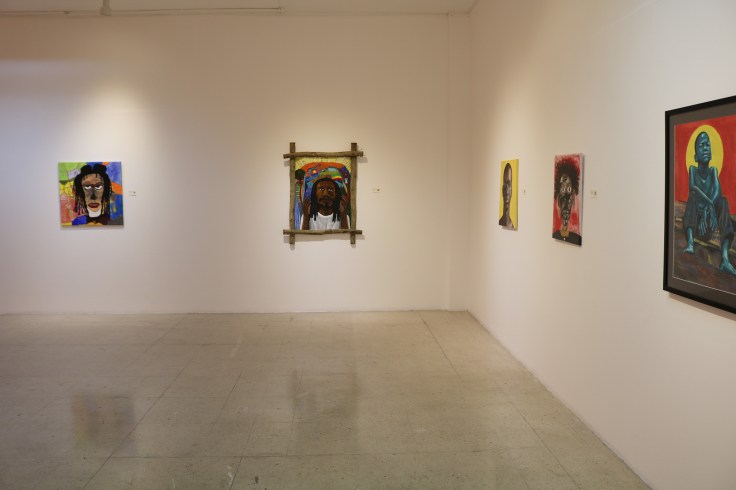
It might have been more productive to consider why such works were submitted in response to the exhibition prompt. Such works dominate the Festival Fine Art exhibition, to the point where some have used the term “Festival art” to describe it. Or to look at the kneejerk responses to Jamaica Day, when the bandana fabric, coal stoves and irons are trotted out all over the country, with very little consideration of any other, more imaginative or contrary possibilities. If the National Gallery wanted to challenge those narrow, predictable representations of Jamaicanness with its exhibition call, which is as such a worthwhile project and discussion, it should have said so clearly. I can imagine that some of the artists who submitted such work were baffled by its rejection, as the production of such imagery is usually rewarded at the national level, as the works that typically receive Festival exhibition medals well illustrate.
The composition of the panel of judges, which consisted of the artist and NLS Executive Director Deborah Anzinger, the collector Herman van Asbroeck, and Monique Barnett Davidson, was disclosed only at the December 10 opening function and in the catalogue, which was launched on that occasion, despite queries from some of the rejected artists and at least one of the invitees at the media briefing. It is not known why the National Gallery felt that this had to be kept a secret. It is, in fact, the norm for juried exhibitions and competitions to publish the names of the judges in the call for submissions for juried exhibitions, or as soon as possible thereafter, as artists have a right to know who will be reviewing their work (with the understanding that artists need to be professional in their responses to the jury decisions, and that jury members should not be personally confronted).
While the call for submissions was well promoted, there appears to be a curious reticence about sharing information about the exhibition itself. Invitations went off only days before the exhibition opening and the media briefing to which only select members of the media were invited (I was not), focused on promoting the participating artists rather than engaging with the contents and critical implications of the exhibition. Since then, there have been regular social media features on the artists in the exhibition, consisting of an exhibition graphic, a photo of the artist, and a short bio with information about the work in the exhibition, but, amazingly, no photos of the work itself, which is a missed opportunity to initiate an online discussion about the issues arising from the exhibition.
There seems to be a view at the National Gallery that not reproducing the work on social media will somehow entice persons to come and see the exhibition. I have never heard of anyone not going to an exhibition because they had already seen it on Facebook or Instagram. Posting well-chosen images on social media is, in actuality, an incentive for persons to go and see the exhibition in real life. A strong social media presence also allows for those who cannot visit, for instance Jamaicans in the Diaspora, to get a better sense of what the exhibition entails. One wonders who advises the National Gallery on its communications strategies. They should perhaps have a look at how other art museums and galleries promote their exhibitions on social media.
The Face of Us continues until March 31 and we must ask about the next exhibition, but the National Gallery is once again holding its cards close to its chest. Not having a published exhibition schedule for 2024 at this time suggests that planning is ad hoc, and not based on a longer vision for a diverse, balanced and well-conceived exhibition programme.
At the information session for The Face of Us we were told that this exhibition was not a replacement for the Summer Exhibition, which is apparently still on the books. This exhibition has not been held since its first edition in 2019, however, and was supposed to alternate with the Biennial. A thorough revision of the concept was certainly needed, but nearly five years later, there should be clarity about the way forward. Since the inaugural Kingston Biennial opened in 2022, furthermore, there should be another biennial this year. The Kingston Biennial is the National Gallery’s flagship exhibition, and the artists and the public have every right to know what is being planned for the next edition. So far, there has been nothing in the public domain on either exhibition.
A reliable source told me that an Osmond Watson retrospective is being planned, which is as such wonderful news, but there is nothing as yet from the National Gallery on that count. If this is indeed scheduled for this year, this should be public knowledge by now. Credible retrospectives cannot be organized on an ad hoc basis, with a few hasty loans from the most obvious and accessible collectors, but require significant organization, critical engagement, and research into the extant work, career and life of the artist, and the production of astute, well-considered critical and scholarly writing on the subject.
The National Gallery has not presented a retrospective since the Barrington Watson exhibition in 2012, which is twelve years ago now. With David Boxer as the lead curator, that retrospective was a massive and well-publicized undertaking by a large team of curators, researchers, writers, editors, organizers, fundraisers and sponsors, with a lot of public support and goodwill involved. An artist of the caliber and cultural significance of Osmond Watson warrants nothing less and I can only hope that the National Gallery will rise to the occasion.
If there would be another, reconceptualized Summer Exhibition or another Kingston Biennial, as well as an Osmond Watson retrospective, and an equal number of high-calibre exhibitions at National Gallery West, 2024 could in fact be a strong year for the National Gallery, with the opportunity to restore previous standards and to mount a vigorous challenge to the growing public scepticism about the state of the institution. It would certainly help if the National Gallery’s forthcoming exhibitions would be public knowledge, as this would garner support, anticipation, and even practical help (for instance with locating little known Osmond Watson works that are in private hands).
One wonders what is happening behind the scenes, as this may help to explain the poor handling of the Gallery’s communications and programmes. I have heard from several impeccable sources that Senior Director, Roxanne (Silent) Bucknor left the organization late last year, after a stint of about a year and a half in that position. If the head of an organization such as the National Gallery leaves, for whatever reason, a prompt public announcement is the norm, but it has been more than a month now, and nothing has been forthcoming. Sound, stable and publicly accountable leadership is of crucial importance in an art museum, but we do not even know who is in charge at the National Gallery right now. This confirms a consistent failure to communicate vital information to the public in a timely manner, even though this goes counter to the principles of public accountability.
This article was originally published, in two parts, in the Monitor Tribune of January 14 and 21. It is reproduced here with a few minor changes.
 Perspectives
Leave a comment