

The title of this year’s final year exhibition at the School of Visual Arts of the Edna Manley College is Undeterred. The titling of this exhibition is always instructive as it is invariably a sign of the times. The current final year students had to contend with some of the most challenging circumstances in recent memory, as the pandemic disrupted the face-to-face interactions and studio time that are so necessary in visual arts education and reduced the income-streams that normally support their studies, while the 2020 fire in the main painting studio reduced the amount of available studio space. Yet they persisted, undeterred indeed, and produced final year work that not only holds its own but also responds to the cultural moment. Theirs is, in effect, the first “normal” final year show since 2019, in the sense that there was a public opening on June 10 and no restrictions on viewing.
The effects of the crisis are however noticeable. This year’s final year cohort is unusually small, consisting of only 29 students, and the exhibition is consequently also smaller than usual. Even though the EMC tuition fees are on the lower side, nationally, it appears that prospective students (and their families and other funders) find it increasingly hard to commit to a four-year art school degree programme. Under those circumstances, a strong move towards those programmes and approaches that meet local market and employment opportunities is to be expected. It certainly helps to explain why there are only four final year students in the Fine Arts (three in Painting and one in Interdisciplinary Studies), as the majority of students have opted for programmes, such as Education and Visual Communication, that have more obvious income-earning potential. The contraction of the Fine Arts programme is not good for art in Jamaica, however, and I can only hope that the numbers will again increase.
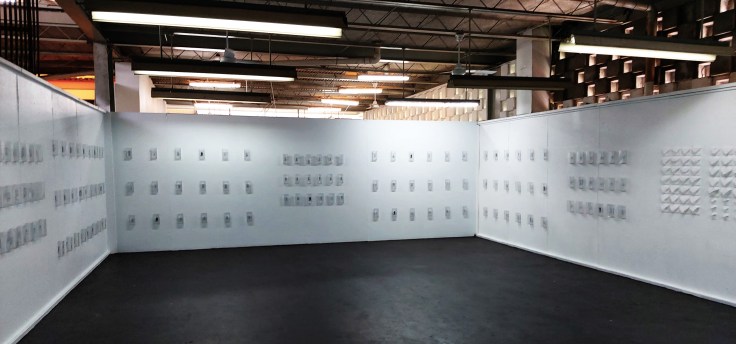
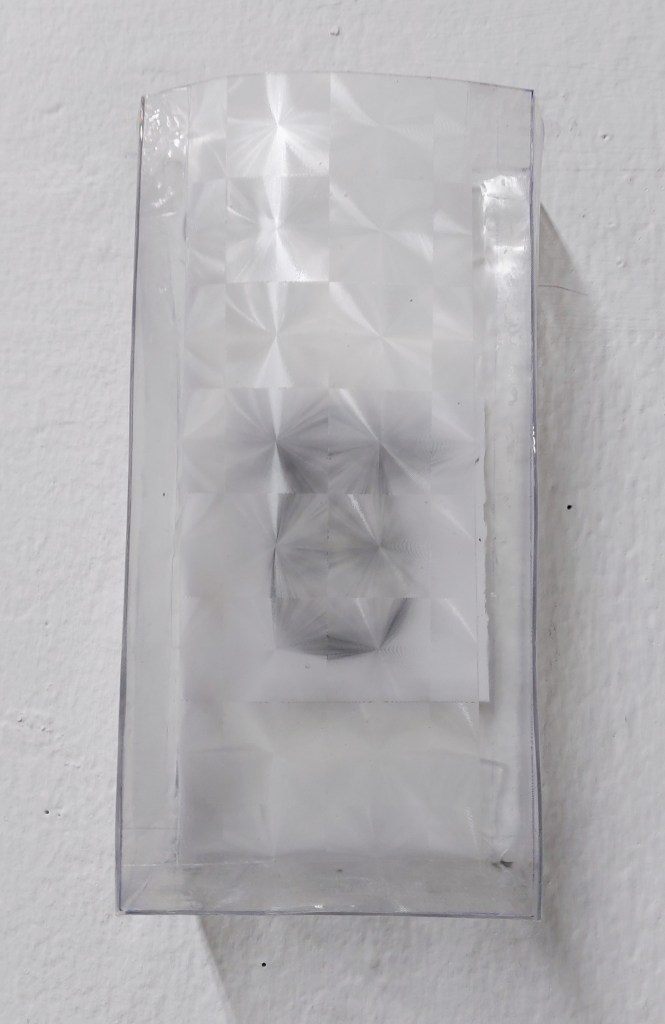
Celine McKenzie’s still, meditative installation Concealment, with its repetitive, patterned placement of small, partially concealed self-portraits and barely visible notes, reflects sensitively on the tension between revelation and concealment in presenting and asserting the self, a tension which has been sharpened in the current cultural context, where lives have become more public and private at the same time. Although the work is materially very different, and moves away more decisively from notions about the permanent “art object”, I was reminded of similar, gendered meditations in the work of Hope Brooks and the late Petrine Archer-Straw.
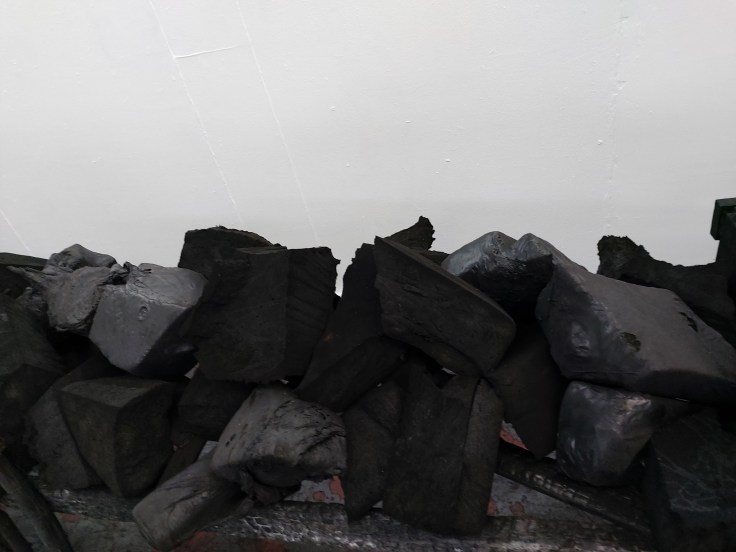
On the surface, there could be no greater contrast between the ethereal luminosity of McKenzie’s Concealment, and the dense blackness, heavy materiality and, arguably, assertive masculinity of the burnt, stained and fractured objects in the neighboring installation Black by Hoween Griffiths. The latter however extends a similar invitation to engage introspectively and almost ritualistically with the space, as it is articulated by the objects, and the meanings that are revealed in the process, although, as with McKenzie, it also calls for its opacity to be acknowledged. Black reflects on the colour black, and its many formal and metaphorical implications in relation to the landscapes, histories and material cultures of the Caribbean (such as charcoal burning and the recycling of car tires), and, in relation to this, to racial blackness – the “Black geographies” Griffiths refers to in his statement.
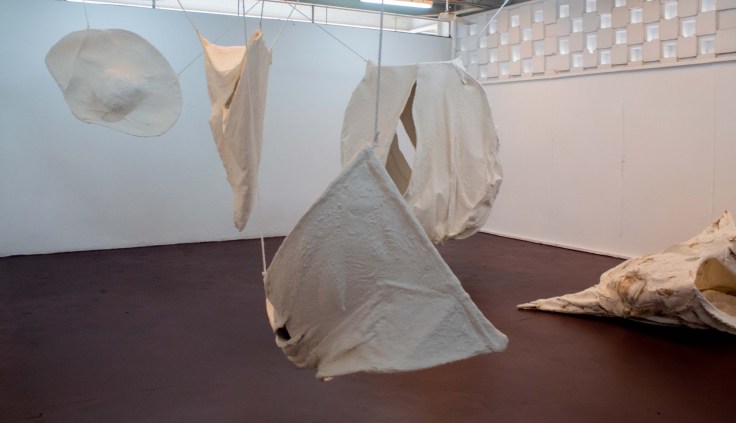
Jaevon Vassell’s rather awkwardly titled The Boundary Between Pornography and Art consists of hanging and draped objects that, as with the previously mentioned examples, disregard and challenge the traditional boundaries between painting, sculpture and installation. Intensely tactile and inviting interaction, even though the forms are quite delicate and enclosed upon themselves, his work explores perceptions about nudity, eroticism, sexuality, gender and the (female) body, but also refrains from making any definitive statements on the subject.
Maurice Hibbert’s ambitious three-channel video installation Masculinity on Display also has a strongly immersive and gendered focus and explores, as his statement tells us, “the complexities of masculinity and identity in Dancehall culture”. Unfortunately, I was not able to experience this video installation fully at the opening and it was closed, because of equipment problems, on the day I returned for a second viewing. From what I saw, however, it appears that the Interdisciplinary Studies programme, which is still relatively new, is coming into its own, with work that is conceptually and thematically sound and technically well-considered – Hibbert is the sole graduating student in that department this year.
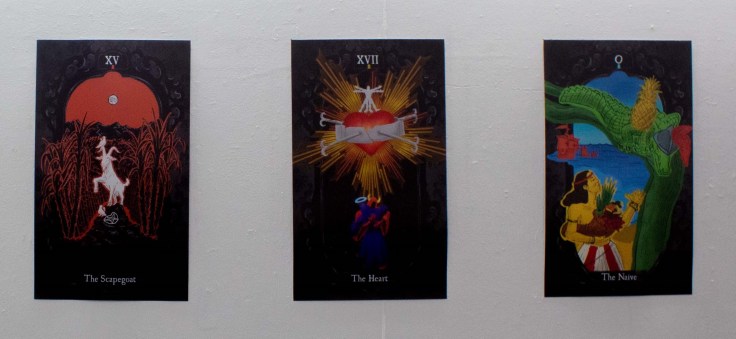
While my focus in this review is on the Fine Arts programme, interesting work was also produced by the Applied Arts Department, and several projects actually challenged those archaic binary distinctions. Three Visual Communication students stood out in that regard. Zack’ry Leslie’s Liberator’s Tarot re-interprets the traditional tarot deck from a decolonial perspective, questioning how some of its archetypes, such as the figure of the Devil, have been traditionally cast. It is tantalizing to consider how this deck could be put into actual play, thus adding a performative element, in ways that add further depth and nuance to their critical meaning.
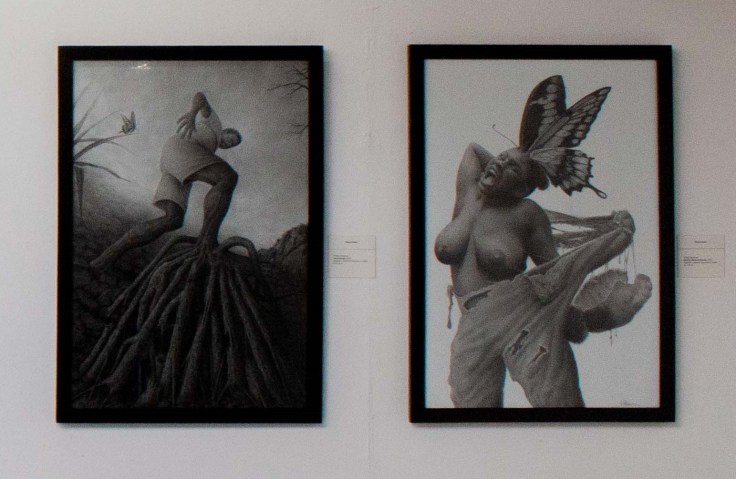
Phillip Robinson, who previously worked as a security guard and attracted national attention a few years ago with his remarkable hyper-realist pencil portrait drawings, has added thematic depth to his impressive technical skills. He uses the visual strategies of surrealism to invoke the process of actualizing the self by shedding the self-perpetuating baggage of generational poverty, representing figures who appear to be willing themselves through a symbolic rebirth and transformation.
Annaleise Virtue’s True Self, my final example, is an immersive installation which takes up an entire corridor at the SVA, which is plastered with text and graffiti-like images and with various objects place in the space, all in stark black and white, to talk about embracing and asserting one’s true self in the face of a cultural dynamic of meaninglessness. If Celine McKenzie’s work whispers, and Phillip Robinson appeals to our imagination, Analeise Virtue’s reflections on personal identity scream loudly and provocatively, but all three ultimately ask very similar questions about self-empowerment.

Curating and exhibiting a diverse array of art and design effectively in the studio spaces of the Edna Manley College is not easy, as the studios are workspaces rather than exhibition galleries. Those students who got a room for themselves were far better off than those who had to share spaces with others, however, as the juxtapositions were not always productive. I wish, for instance, that Phillip Robinson’s stunning pencil drawings would not have to compete for attention with other exhibits, and had also been more sensitively lit.
While it was good to return to a more formalized Final Year exhibition after such a long break, I must also ask whether it was really necessary to have such a long and formal opening function. The function was scheduled to start at 6 pm but it took until after 7:30 pm before we were finally able to view the exhibition, although this should have been the primary focus. There were as many as six scheduled speakers, with all the usual protocols and salutations, as well as an impromptu speech by the Minister of Education, and several performances, in addition to a fashion show of final year work by Fashion Design student Kehomi Thomas.
The remarks of the keynote speaker were, ironically, among the most concise for the evening, although the Minister was, thankfully, also brief and to the point with her comments. I wish that places such as the Edna Manley College would take the lead in dispensing with this culture of hollow formality, and simplify their public functions. They need to understand that by insisting on such an approach, they are also conveying to their students that this is the “right and proper” way to do such things, which only perpetuates the problem.
This review was originally published in the Monitor Tribune of June 25, 2023.
 Perspectives
Leave a comment