
In my review of Narrative Evolutions at the National Gallery of Jamaica (NGJ), I reported that I was promised information on that exhibition, which had opened on May 28, 2023. More than three weeks later, I have still not heard back from the NGJ, and I now have to assume that the information will not be forthcoming. The NGJ has, however, issued an advisory that the Art of Reggae exhibition, which has been on view in the central gallery downstairs since February, has been extended with another month, until July 1. I cannot imagine that there are significant audience demands for such an extension at this time and it may just be that nothing else is ready to take its place. The NGJ has since also issued the call for submissions for The Face of Us exhibition, which will feature portraiture and which will open in December of this year. The framing of this latter exhibition, which seems needlessly prescriptive and restrictive and biased in favour of particular developments in Jamaican art, raises its own questions but I will leave that for my review.
Things do not appear to be any better at National Gallery West (NGW) in Montego Bay. A small exhibition of work by the late Intuitive artist Albert Artwell opened some time in November last year, ambitiously titled Reimagination: The Works of Albert Artwell (there is a striking disconnect between the titles and the substance of NGJ exhibitions these days). There have been no public events attached to this exhibition, and there is as yet no accompanying catalogue publication. The NGW merely announced, a few weeks after its effective start, that the exhibition was “now available for viewing” and would continue until May of this year, in another instance of a needlessly long exhibition run. I was told in response to an email query that the exhibition is still open, but no new closing date was communicated nor was I told of any other plans for the year, even though I expressly asked. I was merely advised to follow NGW’s social media for further info.
These responses, or the lack thereof, suggest that there are significant problems behind the scenes, including poor planning and communication practices, a lack of external accountability, and staff capacity issues. Given the deplorable state the NGJ appears to be in, identifying what exactly happened and who is collectively and individually responsible for the current debacle will be necessary in due time. At this point, it is however far more urgent to take steps to ensure that there is a productive and sustainable way forward for the institution, lest the decline become irremediable. The NGJ is, after all, Jamaica’s national art museum and plays a significant role in the artistic community, the education sector, and tourism. It was once the most active and high-profile museum in Jamaica, and one of the leading art museums in the Caribbean, a regional leadership position Jamaica should not take for granted as there is now stiff competition in that field.
Below are some reflections on what should be done, in my estimation, delivered in the hope that they may contribute to a constructive dialogue about the way forward. There are, after all, opportunities in every crisis, and with some goodwill, initiative, inclusive consultation, and imagination a better NGJ could in fact emerge.
Governance and the Board
Good governance is crucial to the sustainability of any institution, the NGJ included. As an important part of this, there needs to be a representative, inclusive, well-informed and effective Board that serves as “the custodian of the public interest,” to borrow the terms used to describe the general responsibilities of the Board of the Tate Gallery in England. It should be clearly understood, therefore, that the NGJ is publicly owned, and not a political trophy or personal turf, and that the institution ought to conduct its affairs accordingly, in an inclusive, open and transparent manner.
The current Board of Directors of the National Gallery, which is headed by the President of the Senate and senior JLP politician Tom Tavares-Finson, of has been in place since 2016. This Board was re-appointed, with only a few changes, for a second term in 2019 and presumably for another three years, and its second term would thus normally have ended last year. The current Board’s performance has been unimpressive, to put it mildly, so it would be ill-advised to re-appoint it for a third term, or to extend its life any further. Radical change is needed. A new, carefully chosen Board should be appointed, with balanced and inclusive leadership and membership. This new Board should be as devoid as reasonably possible of the intrigues and politics that have weighed down the previous one and there should be no scope for inappropriate micromanagement.
The long-awaited Public Body Management & Accountability (Nomination, Selection & Appointment) Regulations (2021) are now finally in effect. It is disappointing that appointments continue to be at the discretion of the portfolio Minister and will, as before, automatically end at any change of administration or minister, leading to the inevitable confusion and abrupt changes in direction and personnel in the operations of public bodies. A more democratic and independent appointment mechanism, with nominations from agreed stakeholder groups and an elected chair would have been a major step towards depoliticizing Board and other Public Sector appointments but it appears that the current government is not prepared to take that step.
There are nonetheless improvements in the new regulations. One is that members of the houses of Parliament and local government Councillors can no longer serve on public boards, as it is now finally recognized that this poses an inherent conflict of interest. This means that the NGJ should at least get a new Chair. The other is that there is now a register of prospective Public Board members, to which qualifying persons can add their profile, although there is no guarantee that any particular candidates will be selected, in what will inevitably remain a highly politicized process. There are also new mechanisms for accountability and redress, which hopefully will make a difference. It would be tragic if the new regulations would just amount to window dressing, as substantive change is urgently needed in public sector governance.
The new NGJ board should have published terms of reference, based on a sound understanding of the institution’s mandate and its most pressing problems. And there should be a code of ethics, as many major museums now have for their boards and senior staff, and an annual declaration of assets and interests, so that the conflict-of-interest issues that inevitably arise in small, closely knit societies can be appropriately mitigated. The Tate Gallery, in the UK, publishes both on its website and its members are, more generally, expected to adhere the Seven Principles of Public Life, namely: Selflessness (acting in the public interest), Integrity, Objectivity, Accountability, Openness, Honesty, and Leadership (in matters of integrity). These Principles, which are also known as the Nolan Principles, were adopted by the British Government in 1995 and articulate the best practices for conduct in public offices. These principles are, by the way, also the ones used in the Code of Conduct of Jamaica’s Integrity Commission, which Cabinet members have refused to sign, although its provisions are entirely reasonable and widely accepted, internationally.
Some museums, such as again the Tate, are also mandated to publish their Board minutes on their website. Doing this here would represent a vast improvement in transparency and it would serve as a deterrent for inappropriate conduct in meetings. It would certainly be an eye-opener for the public if this were done retroactively for the NGJ, all the more if the audio-recordings and certain written Board communications were included!
Mandate
For much of the history of the NGJ, which will be fifty years old next year, there have been broad assumptions regarding its mandate, general functions, and underlying vision, but these are under-articulated and need to be updated, as this lack of clarity of purpose has contributed to the institution’s troubles. The mission statement, which was articulated about twenty years ago, reads as follows: “To collect, research, document and preserve Jamaican, other Caribbean Art and related material and to promote our artistic heritage for the benefit of present and future generations.” While generic, this mission statement at least acknowledges that the core functions of the NGJ are its public ones.
In recent years, there has been global debate about museums and the need to decolonize their operations and the values and agendas upon which they are premised, and to become more responsive to their communities. There has however been only limited museum activism and debate in the Caribbean, and very little published literature on the subject. The time has come for such conversations to take place in Jamaica, and to involve local museums such as the NGJ.
We need to ask what museums are here to do, whose interests they are supposed to serve, how they should engage with stakeholders and audiences, and what perspectives they should represent in their exhibitions, publications and programmes. We also need to ask whether the traditional, hierarchical governance and operational models, including the “national gallery” designation, are relevant here, and what other, more appropriate approaches could take their place. These are not things that can be decided on in a closed Board retreat but require comprehensive, inclusive, and well-informed stakeholder consultations. Facilitating such a conversation, and responding imaginatively and effectively to its outcomes, could be a real game-changer for the NGJ, and for museums in the Caribbean in general.
Programmes and Team
Along with such general rethinking, urgent improvement is needed regarding the NGJ’s handling of its exhibitions and programmes. Museums normally plan ahead for at least five years. This is not only necessary to the effective management of resources, funding, and operations, but it also ensures that the exhibitions and programmes are sufficiently diverse and balanced, and cover the range of what is expected from that museum. Naturally there needs to be some flexibility, in case of unexpected circumstances (as we had recently with the pandemic), but such a “big picture” approach seems to be lacking at the NGJ. The strong focus on the Biennial, and its appeals to international prestige and visibility, appears to have resulted in insufficient attention to what would follow, hence the eleventh-hour, ad hoc approach to this year’s exhibition programme. The Biennial and whatever “open call” exhibition it will now alternate with, can however not be the sole anchors of the NGJ’s exhibition programme, with mere “fillers” in-between, as there also need to be retrospectives, historical and thematic exhibitions, and exhibitions that serve specific, developmental purposes such as young artist exhibitions, just to name a few types.
Tellingly, there has been no retrospective since the Barrington Watson retrospective in 2012, and the last Young Talent exhibition was in 2015, although that exhibition series has launched the careers of several Jamaican artists. Retrospectives require significant preparation, as they need to present a comprehensive, scholarly sound investigation of an artist’s work, but the NGJ should certainly be able to produce two per decade. The wait list includes Gloria Escoffery, Osmond Watson, Hope Brooks, Colin Garland, Milton George, and David Boxer, all artists who are rapidly dropping from the public consciousness, yet there is no word on whether any of these are forthcoming.
The question is, however, whether the NGJ currently has the capacity to produce such exhibitions, as it has all but stopped producing new research and critical scholarship. There is at present no art historian on staff, for the first time since David Boxer was appointed in 1975. With “art historian” I mean someone who studied in a structured Art History programme and who furthermore has a solid record of original research and scholarly publications, and other discipline-related work. For the NGJ, this should ideally involve work in subject area that is directly relevant to the museum’s mandate, namely Jamaican and Caribbean art. I am not suggesting that persons with adjacent qualifications cannot make important contributions, but not having even one art historian on staff is unusual for a museum that is supposed to be the institution of reference for art historical scholarship in and about Jamaica. It is a skills gap that needs to be addressed urgently.
The bigger point is of course that cultural institutions cannot afford to be cavalier with their human resources, as these involve (or should involve) rare skills. There have been too many “own goals” with regards to HR practices in the Jamaican cultural sector in recent years. Specialist skills may be scarce, and their importance poorly appreciated, locally, but there are well-regarded Jamaican professionals in the diaspora. Many would be happy to return if the circumstances would be sufficiently attractive, not only in terms of salaries and resources but also in terms of a wholesome work environment, although this is difficult in an institution that is so racked by politics. The same general needs and expectations of course also apply to the local professionals, as there appears to be significant demoralization. The structure, development, skill sets, and welfare of the NGJ staff, and the circumstances under which they work, need urgent attention, as the current situation will get worse if staff members continue to opt out.
Building and facilities
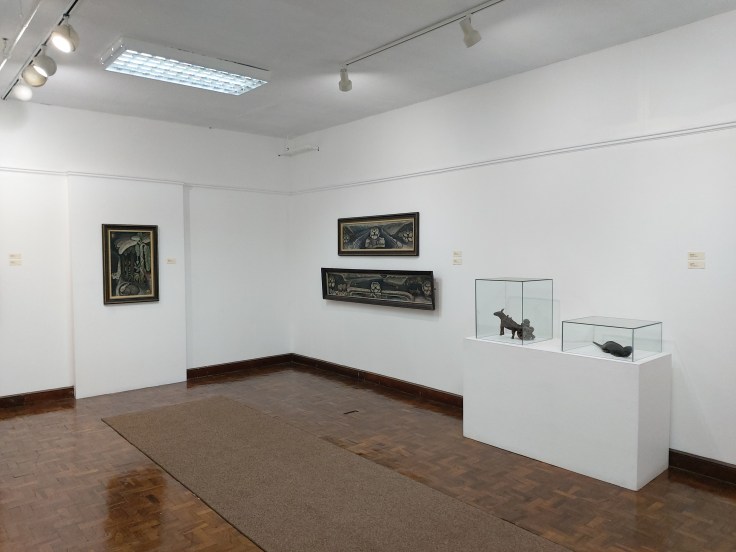
On my most recent visit, I viewed the reinstalled Dunkley gallery. There is no air conditioning, resulting in sweltering temperatures, which is detrimental to the conservation of Dunkley’s delicate paintings and carvings. The blinding white walls and ceiling, and blaring lights are furthermore completely inappropriate to Dunkley’s work and there is nothing in the room to contextualize it. The building and facilities at the NGJ are indeed another pressing matter, along with ill-advised curatorial practices that aggravate these problems.
The NGJ moved into its building on the Kingston Waterfront in 1982-83, as what was supposed to be a temporary, five-year arrangement while a new building was constructed, but it has been in these “temporary” facilities ever since. There needs to be a firm decision on whether the NGJ should in fact remain there, with due consideration for new environmental hazards such as sea level rise, as this is a known risk in the Kingston Waterfront area. There were plans for an international architectural competition and fundraising campaign to redevelop the building, but these appear to have evaporated after I left. At the very least, even if the NGJ will just stay there temporarily for a few more years, the building needs to be stripped and reconfigured to accommodate the NGJ’s evolving needs, and equipped with up-to-date and functional infrastructure. It is a pity that this was not done during the extended pandemic closure. There is new carpet upstairs, which seems like a waste, as it would have been much wiser to replace the antiquated flooring with museum-quality, high-traffic flooring.
The building, which was originally to house a Woolworth’s department store, is in essence an open concrete shell, which has been configured with plywood partitions. That is not recommended for a museum, because of the health, conservation, termite, and fire hazards involved. Lighting is an unsightly hodgepodge unsuitable for a major museum and also needs to be upgraded. The antiquated central air-conditioning system, for which spare parts are no longer available, should have been removed years ago and upgraded to an energy-efficient, museum-quality climate control system. It is also time for the NGJ building to become wheelchair-accessible, with an elevator and bathrooms on both floors, as it is not compliant with the accessibility standards that are now in effect for public buildings. None of this is beyond the reasonable reach of the NGJ and the inaction on this count is incomprehensible.
There are many other things that need urgent attention at the NGJ – a communications policy being one – but I have outlined some of the most pressing issues. Hopefully, by the time the next exhibition opens in December, there will have been some positive action.
An earlier version of this article was published in two parts (as part of the three-part feature on the Narrative Evolutions exhibition) in the Monitor Tribune of June 11 and 18, 2023.
 Perspectives
Leave a comment